
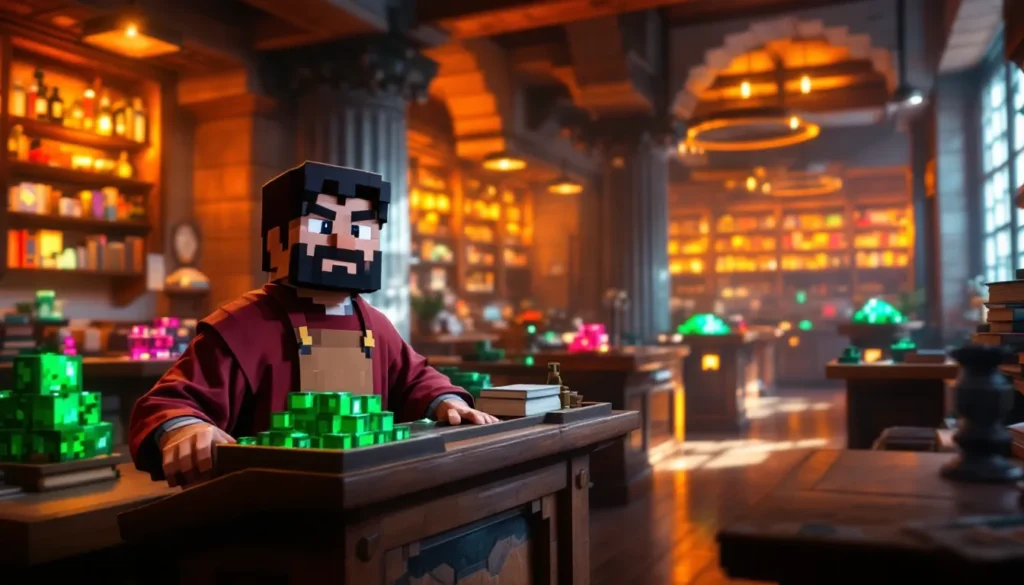
Minecraft librarians are arguably the most valuable NPCs in the entire game, and that’s not hyperbole. Whether you’re hunting for Mending, setting up an endgame enchantment factory, or just trying to skip years of grinding at the enchanting table, librarians are your answer. These robed scholars can trade you everything from rare enchanted books to maps to hidden treasures, making them essential whether you’re playing vanilla survival or managing a massive multiplayer server. The librarian trade system is deceptively deep: it involves understanding professions, employment mechanics, restocking cycles, and optimizing your trading hub for maximum efficiency. In this guide, we’ll break down exactly how to find librarians, which trades matter most, and how to build a setup that turns these NPCs into your personal enchantment vending machine.
Key Takeaways
- Minecraft librarians are essential NPCs that break the enchanting RNG ceiling by trading rare enchanted books like Mending, Silk Touch, and Unbreaking III for emeralds, eliminating months of grinding at the enchanting table.
- Librarians are identified by their burgundy robes, brown aprons, and lectern workstations; you can create new ones by placing a lectern near any jobless villager.
- The top-priority librarian trades include Mending, Silk Touch, Unbreaking III, Sharpness V, Protection IV, and Infinity—books that define endgame progression and survival efficiency.
- Build a scalable trading hub with individual stalls for multiple librarians grouped by trade type, ensuring redundancy (at least two librarians per essential book) to manage price increases from the demand system.
- Reset a librarian’s trades before first use by breaking their lectern to get a fresh book roll, but once you trade with them, their books are locked in permanently for that cycle.
- Zombify and cure librarians in endgame play for 50-80% price discounts, turning expensive books like Mending from 20-30 emeralds down to 8-10 emeralds per trade.
What Are Minecraft Librarians and Why They Matter
Librarians are cleric-type villagers that spawn exclusively in libraries within generated structures like villages, mansions, and outposts. They wear burgundy robes and brown aprons, making them instantly recognizable once you know what to look for. Unlike farmers or armorers who have predictable single-trade routes, librarians offer randomized enchanted book trades that can include nearly every enchantment in the game.
Why do they matter so much? Because they break the enchanting RNG ceiling. Finding Mending through pure enchanting table luck could take literal months of grinding. A librarian can sell it to you for 5-64 emeralds and some experience bottles. Want Silk Touch without wasting your best anvil setup? Librarian. Need Protection IV but don’t have the books? Librarian. The same applies to utility enchantments like Infinity, Sharpness V, and nearly every other sought-after book in the game.
Beyond enchanted books, librarians trade maps to structures (Woodland Mansion maps, Ocean Explorer maps), which open up entirely new progression paths. They’re not flashy, but librarians are the reason speedrunners can skip the grind and why casual players can actually achieve their builds without losing sanity to the enchantment table’s chaos.
How to Find and Identify Librarians
Locating Villages and Librarian Structures
Librarians naturally spawn in villages, but not every village has one. Larger generated villages with library structures (the multi-floor buildings with stairwells and bookshelves) are your best bet. If you’re playing on a newer version (1.21+), villages generate more reliably with dedicated library buildings, so fresh chunks are worth exploring.
Librarians also spawn in Woodland Mansions (accessible via maps traded by other librarians, creating a fun loop), and they occasionally appear in outposts. In vanilla Survival, finding the right village is often faster than deep exploration early-game. Use the F3 debug screen (Java Edition) or navigate towards generated structures systematically.
If you’re impatient, mods on Nexus Mods exist for structure highlighting and biome searching, though these obviously remove some survival difficulty.
Identifying Librarians by Appearance and Workstations
Librarians wear burgundy robes with brown aprons, distinctive enough that you can spot them from a distance. More importantly, they have a lectern as their workstation. This is the key identifier. If a villager is standing near or interacting with a lectern, they’re a librarian or about to become one.
In career-limited villages, librarians are already employed (the lectern is claimed). In newer villages or custom setups, you can assign any jobless villager to become a librarian by placing a lectern near them. They’ll claim it within seconds and transform into their robed form. Each librarian can only be assigned to one lectern, and moving the lectern will cause them to unclaim it and revert to jobless.
Always check what trades a librarian has before committing to them. Their stock is randomized per librarian, so one library might have exactly what you need while another is full of garbage trades like Thorns III books.
Understanding the Librarian Trade System
How Trading Mechanics Work
The librarian trade system operates on a simple model: you bring emeralds and they give you items (or vice versa). Each librarian typically offers multiple trades, but you’ll only see one or two at a time until you level up through transactions. Every time you complete a trade with a villager, you gain experience toward unlocking their next tier of trades.
One crucial mechanic is the demand level. If other players (on multiplayer servers) trade heavily with a librarian, the price increases for subsequent trades. This is why large-scale librarian hubs need multiple librarians per enchantment, to spread trading pressure and keep prices low. Prices also reset during midnight (in-game time), so if a librarian gets expensive, just wait for a reset or trade with someone else.
Trades are locked in once discovered. If a librarian’s first-tier book is Thorns and you don’t want it, you have two options: (1) never level them up and use another librarian, or (2) break their lectern to reset them entirely. A reset causes them to become jobless again, and you can reassign them for a fresh trade roll. This is the fundamental strategy behind optimizing librarian setups, rolling until you get the books you want.
Experience Levels and Their Impact on Trades
Librarians have five experience levels (Novice, Apprentice, Journeyman, Expert, Master), each unlocking new trade options. You progress by trading with them. A single trade might only give a tiny amount of XP, so reaching Master typically requires multiple transactions across several in-game days or using the demand-reset cycle strategically.
Higher-tier librarians don’t always offer better books, they offer different books. A Novice might have Mending, while an Expert has Unbreaking III. This is why checking trades before committing is essential. You don’t want to level someone to Expert only to discover they don’t have what you needed.
Prices scale somewhat with experience level, but more importantly, they scale with demand and how many times you’ve traded with that specific villager. A heavily-traded librarian’s prices climb toward late-game costs (20-30+ emeralds), while fresh librarians stay cheap (as low as 1-5 emeralds for common books).
Essential Librarian Trades for Every Player
Enchanted Books and Rare Enchantments
Not all enchanted book trades are equal. Some books are so rare or useful that failing to grab them is a strategic mistake. Here’s the tier-1 priority list:
Must-Have Enchantments:
- Mending, Arguably the most valuable book in the game. Any tool or weapon with Mending repairs itself through XP orbs. Librarians are the only practical source.
- Silk Touch, Essential for obsidian, glass, ice, and other blocks that drop nothing under normal mining.
- Unbreaking III, Massively extends tool longevity, making it essential for any long-term survival.
- Sharpness V, Top-tier damage enchantment for swords: every combat player needs at least one.
- Protection IV, Armor enchantment that reduces all damage types. The defensive equivalent of Sharpness.
- Infinity, Bows fire infinitely with one arrow, eliminating arrow consumption for hunting and combat.
Very Useful Secondary Trades:
- Looting III, Increases mob drops, making it invaluable for farms and combat.
- Fortune III, Doubles ore output, cutting mining time in half for certain blocks.
- Efficiency V, Speeds up mining significantly: less critical than Unbreaking but still valuable.
- Respiration III & Aqua Affinity, Quality-of-life underwater gear. Not essential but beloved by builders and explorers.
Situational/Niche:
- Curse of Binding & Curse of Vanishing, These are ‘curse’ books that attach negative effects. Some players collect them for roleplay: most avoid them entirely.
Guides on sites like Twinfinite often highlight meta enchantment priorities, which align closely with this list.
Other Valuable Items and Resources
Beyond enchanted books, librarians trade a few other high-value items. Woodland Mansion maps and Ocean Explorer maps are available from some librarians and open entire new areas with loot (mansion has totems of undying: ocean has buried treasure). These maps are quest-starters that justify trading emeralds immediately.
Librarians also sometimes trade clock and compass items, but these are low-priority since they’re easy to craft. The real non-book value comes from maps and the fact that having a reliable librarian hub lets you focus on other aspects of the game instead of grinding emeralds elsewhere.
Some enchantment combinations are meta-defining. A sword with Sharpness V, Looting III, and Mending can handle end-game content indefinitely. These multi-enchantment tools are why librarians form the backbone of progression, they enable the gear you actually want to use.
Librarian Mechanics and Employment
How to Employ and Manage Librarians
Employing a librarian is straightforward: place a lectern near a jobless villager, and they’ll claim it within about a minute. The villager transforms into a librarian and becomes locked to that lectern. If you remove the lectern, they revert to jobless and will seek a new profession.
Management becomes important when scaling. On multiplayer servers or in personal megabases, you might have 20+ librarians. Each needs its own lectern (they can’t share), and they need to be protected from mob damage, fire, and suffocation. A common setup is individual 1×2 trading stalls separated by blocks, each with a lectern and a trapdoor to prevent escaping.
Librarians breed with each other if fed bread or crops, so you can actually farm librarians rather than hunting them down. But, bred librarians have the same randomized trades as wild ones, so you still need to roll through lecterns to find what you want. This is more useful for getting backup copies after you’ve already found the books you need.
Restocking and Demand Systems
Once a librarian’s trades are locked in (you’ve leveled them enough to see all their offers), they operate on a restock cycle. Librarians restock once per in-game day (can be sped up by waiting or exiting/re-entering chunks). This means if a librarian has Mending and you buy it, they’ll have Mending again tomorrow.
But, if multiple players trade heavily with the same librarian, prices increase due to the demand system. On multiplayer servers, this means a Mending book might cost 5 emeralds on day one and 20+ by day five. The solution is having redundancy: multiple librarians per book type spread the trading load.
Prices reset when the calendar flips or when significant time passes. If a librarian gets expensive, simply switch to another librarian with the same book or wait. This is why optimized hubs have at least two librarians per essential book (like Mending), ensuring prices stay reasonable even with heavy trading.
Zombification offers another advanced strategy: you can zombify a librarian by letting a zombie attack them (they’ll survive as a zombie villager), then cure them with a weakness potion and golden apple. The cured librarian has the same trades but much lower prices (sometimes 50-80% discount). This is an endgame optimization once you have sufficient resources.
Advanced Strategies for Optimal Librarian Setup
Building an Efficient Librarian Trading Hub
A trading hub is a dedicated structure (or room) housing multiple librarians organized by utility. The layout matters for both efficiency and scalability.
Basic Hub Design:
- Individual Trading Stalls: Each librarian gets a 2×2 or 1×3 space with a lectern, trapdoor (to prevent escaping), and a player standing area.
- Organization: Group librarians by category (Enchantment Books, Maps, Utility) so you know where to find what you need.
- Lighting: Ensure adequate lighting (light level 9+) to prevent hostile mobs from spawning inside.
- Access: A simple hallway or main path connecting stalls lets you quickly navigate and trade.
Advanced hubs add refinements: item sorters feeding emeralds from external farms into hoppers above librarian stalls (Java Edition only), nametags to prevent accidental despawn, and redundancy (multiple librarians per essential book).
On Game8, detailed hub blueprints show how top players minimize travel time and maximize stall density. A well-planned hub might fit 20-30 librarians in the space of a small building.
Maximizing Emeralds and Trade Efficiency
Emeralds are the currency, but how do you get them? Most players farm them through mob grinders (zombies, skeletons), mining, or trading goods from farms (wheat, melons, pumpkins) to farmer villagers.
Once you have emeralds, trade efficiency comes down to book prioritization and demand management. Don’t waste emeralds on low-priority books: focus on the must-haves first (Mending, Silk Touch, Unbreaking III). Some players pre-plan their entire equipment loadout and only trade for books they’ll actually use, avoiding wasteful transactions.
Price optimization through zombification is a late-game move but massively extends emerald purchasing power. A Mending book that costs 30 emeralds normally drops to 8-10 after curing a zombified librarian. Multiply that across 10+ books, and you’re saving hundreds of emeralds.
Finally, avoid rolling librarians you don’t need. Each book roll through leveling costs trading resources. If you’ve already acquired Mending from one librarian, don’t spend emeralds leveling another librarian fishing for a duplicate, just use the original for daily restocks. This discipline keeps your emerald spending lean.
Common Librarian Challenges and Solutions
Problem: Librarian Got the Wrong Book
Solution: Break their lectern immediately before you trade with them. They’ll revert to jobless, and you can reassign them with a new lectern for a fresh trade roll. This resets their entire trade list, so you can try again without loss. If you’ve already traded with them, you’re committed, that book is locked in.
Problem: Prices Are Too High
Solution: Demand increase or you’ve traded too many times. Either (1) stop trading that librarian and switch to another, (2) wait for the daily restock (which sometimes resets prices), or (3) zombify them for a massive discount. On multiplayer servers, coordinate with other players to spread trading pressure.
Problem: Can’t Find the Book You Need
Solution: This is RNG. Librarians have randomized first-tier trades, so you might need to roll 10+ librarians to find a specific book. Set up a “rolling station” where you quickly assign and reassign lecterns, checking each librarian’s first trade until you find what you want. It’s tedious but way faster than waiting for the one wild librarian in a village to have the right book.
Problem: Librarian Despawned or Got Killed
Solution: Name-tag them with /give @s name_tag or anvil them. Nametags prevent despawning and help you track important librarians. If untagged, they can despawn if no player is nearby after 2+ days. Protect your hub from mobs by ensuring proper lighting and walls.
Problem: Villagers Are Breeding and Cluttering the Hub
Solution: Separate librarians with blocks or use fencing. Ensure they don’t have consistent access to bread/crops, which triggers breeding. Alternatively, let them breed and cull excess villagers, some players maintain a small reserve librarian pool for backup.
Problem: Confused About Trade Tiers
Solution: Each librarian starts with one visible trade. As you trade and gain XP with them, more trades appear. You only see new trades after leveling up, so it’s not immediately obvious what a librarian has to offer. Check online tier lists (many wiki sites list common librarian trades) or systematically unlock each tier by trading cheap items.
Conclusion
Minecraft librarians transform from random NPCs into the backbone of endgame progression once you understand their mechanics. Knowing where to find them, how to roll for specific books, and how to optimize a trading hub separates casual players from those with endgame armor and weapons that feel truly powerful. The librarian trade system isn’t complex, but it rewards patience, planning, and a bit of strategic thinking.
Whether you’re building your first trading hub or fine-tuning a massive one on a multiplayer server, the fundamentals remain the same: identify the books you need, secure multiple librarians per essential trade, manage prices through demand awareness, and don’t waste resources on books you won’t use. Start small with a single librarian for Mending, expand from there, and you’ll eventually have a self-sufficient system that frees you from emerald farming and lets you focus on actual building and exploration.
The librarian trade system might seem intimidating at first, but it’s one of Minecraft’s most satisfying mechanics once you crack it. Your future self, decked out in perfect gear with Mending tools that never break, will thank you for taking the time to set it up right.
More Stories
Minecraft: The World Of Gaming Madness At ThePlayCentre — Your 2026 Guide
Inside ThePlayCentre Minecraft Archives: A 2026 Guide To Maps, Builds, And Community History
Bane Of Arthropods In Minecraft: Master The Enchantment In 2026 (ThePlayCentre Guide)