

Synthetic speech has followed an unusual commercial trajectory. It reached technical adequacy several years before it reached enterprise adoption, held back not by output quality but by rights ambiguity, integration friction and internal resistance from communications teams.
Those barriers have eroded substantially over the past two years. Procurement discussions have shifted from whether synthetic narration sounds acceptable to how it slots into existing content pipelines and what its licensing exposure looks like at volume. That transition marks the point at which a category stops being experimental and starts being budgeted.
Voice Was the Last Component of Content to Industrialise
Text production industrialised first, then imaging, then video assembly. Audio narration lagged behind all three, for reasons that were operational rather than technical.
Voice carries identity in a way other assets do not. A logo can be standardised without controversy; a voice is perceived as belonging to someone, which made organisations cautious about synthesising it. Secondly, narration sat awkwardly between departments — owned by neither the video team nor the copy team — and unowned processes rarely get optimised.
The consequence is that voice production remained a manual bottleneck inside otherwise automated pipelines. Organisations could generate a training module’s script, visuals and structure in hours, then wait a fortnight for a booked voice artist. That mismatch is precisely what created the current demand.
Integration Depth Is the Emerging Differentiator
Output naturalness has converged across leading vendors to the point where blind comparison rarely produces a decisive preference. Competitive separation is therefore moving to the workflow layer.
Pollo AI’s AI Voice Generator illustrates the direction. Beyond producing broadcast-standard narration from typed input within minutes, it maintains a catalogue exceeding one hundred voices that can be filtered by accent, gender and delivery register, with context-aware rendering and adjustable pace, pitch and emotional weighting — capabilities that address the specific complaint enterprise buyers raise most often, namely that early synthetic audio sounded uniform across content types that required different tones.
The commercially significant element, however, is pipeline connection. Generated audio passes directly into an associated video project with automatic synchronisation, eliminating the export-and-realign step that has historically consumed a disproportionate share of production hours. For a scalable voiceover production workflow, removing that handover matters more to unit economics than incremental gains in naturalness.
Application breadth extends across short-form social, promotional film, podcasting and audiobook production, which positions the category against several distinct budget lines simultaneously.
Cost Displacement Rather Than Straightforward Saving
Market commentary frequently frames synthetic voice as a direct substitution for voice talent expenditure. Deployment data suggests a more complex pattern.
Organisations adopting these tools rarely reduce audio budgets. They redirect them. Spend previously consumed by routine narration — internal training, product updates, localisation of existing material — shifts towards volume and coverage. Content that was never narrated at all because it could not justify a booking now receives audio, while flagship brand work frequently retains human talent.
The strategic reading is capacity expansion rather than headcount displacement. Buyers modelling these tools purely as a savings line consistently underestimate both the realised return and the process redesign required to capture it.
Enterprise Deployment Framework
Segment Content by Narration Sensitivity
Classify existing output by volume, longevity and brand exposure. High-frequency, low-sensitivity material — internal briefings, procedural updates, product documentation — delivers returns fastest. Customer-facing brand campaigns typically retain human performance. Organisations evaluating a platform against their most sensitive use case rather than their most frequent one routinely reach the wrong procurement conclusion.
Standardise a Voice Specification Before Scaling
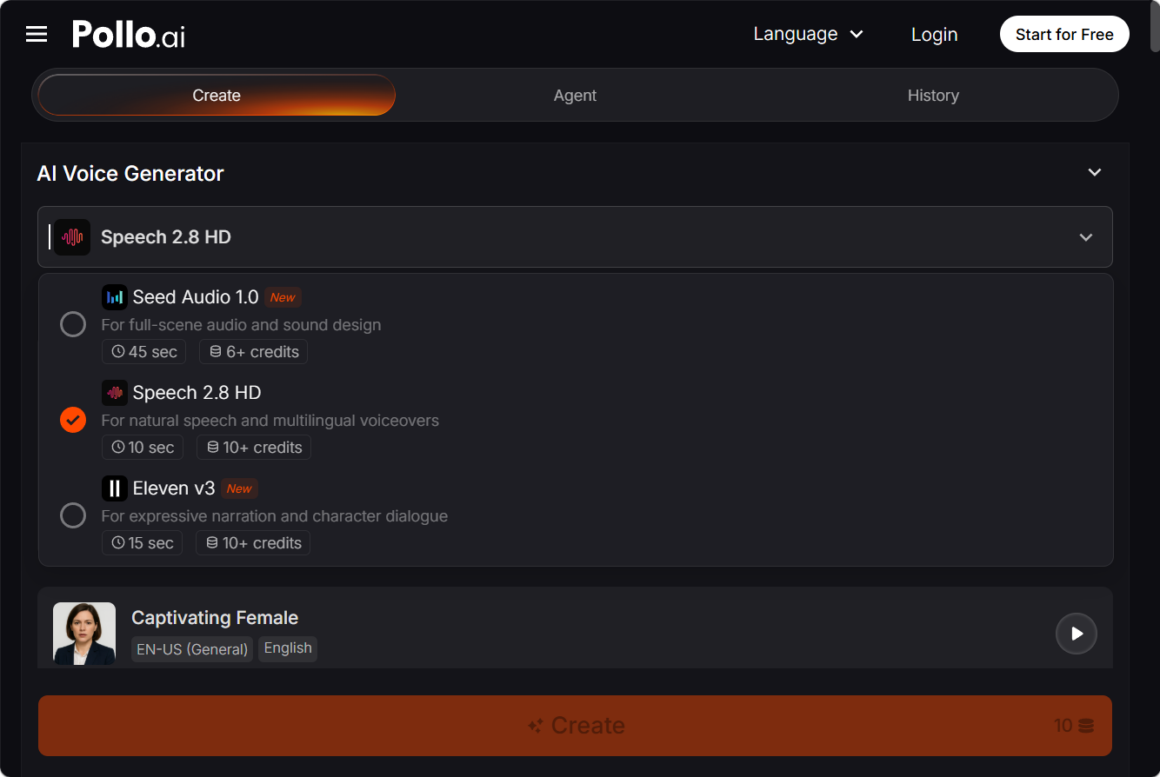
Define the parameters in advance: which voice profile represents which content category, target pacing, and tonal register per format. Applying a consistent specification through Pollo AI’s AI Voice Generator across an entire content library is what converts scattered individual outputs into a recognisable audio identity, and specification defined at generation is far cheaper than correction at review.
Pilot a Complete Content Stream End to End
Run one full workstream rather than distributing trial access broadly. Contained pilots produce measurable cycle-time data; scattered experimentation produces anecdotes. Measure brief-to-published duration rather than time to first audio file, since approval loops contain most of the actual elapsed time.
Establish Disclosure and Rights Governance Early
Assign explicit accountability for usage rights and, where relevant, audience disclosure. Regulatory attention to synthetic media is increasing, and retrofitting governance across a published library costs substantially more than establishing it before scaling.
Adjacent Segment: Text-Driven Video Assembly
Voice generation addresses one component of the content stack. Visual assembly represents a parallel segment with overlapping buyers and distinct competitive dynamics.
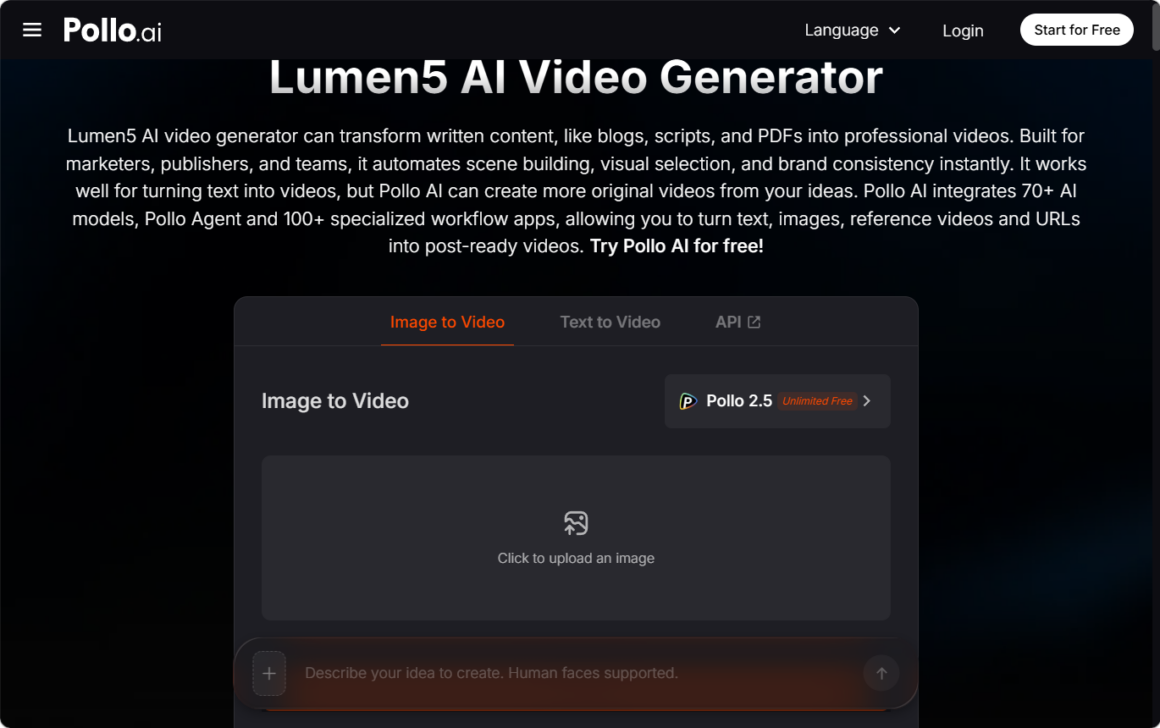
Lumen5 AI video generator operates in that space, converting written source material including articles, scripts, PDFs and web pages into structured video by drawing footage and music from an extensive library and assembling scenes automatically. It offers narration and virtual presenters across more than forty languages, with brand templates and design rules maintaining visual consistency — positioning it towards marketing departments, publishers and internal communications functions.
The segmentation is commercially meaningful. Voice platforms compete on naturalness, control granularity and pipeline integration. Assembly tools such as Lumen5 AI video generator compete on source-material flexibility and template governance. Enterprises increasingly procure across both, treating them as sequential stages rather than competing purchases.
Indicators to Monitor
Three signals merit attention as enterprise AI audio production matures.
The first is licensing consolidation. Vendors offering unambiguous commercial rights and clear voice provenance hold a structural advantage as scrutiny of synthetic likeness increases.
The second is multilingual depth. Localisation is where the strongest measurable returns appear, and coverage breadth is becoming a primary selection criterion rather than a secondary feature.
The third is workflow embedding. Tools requiring manual file handling between generation and publication will lose ground regardless of audio quality, because handover cost dominates total production time at volume.
Outlook
The category is settling into a stable structure: voice platforms handling narration at operational scale, and assembly tools serving text-to-video conversion for marketing and internal communication.
For buyers, that stability is useful. Selection can now proceed on operational criteria — integration depth, rights clarity, language coverage — rather than on audio comparisons that will be obsolete within two quarters. The organisations realising genuine value are not those with the most natural-sounding output, but those that restructured their approval workflows to match the production speed they acquired.
More Stories
Budget Planning For Galaxy Shop & ThePlayCentre: The Practical Ebook To Save Money And Grow In 2026
Rolmaren Endrik: ThePlayCentre Author Who’s Reimagining Childhood Adventure (2026 Profile)
Thomas McCarty And The Play Centre: The Vision That Reimagined Childhood Play In 2026