
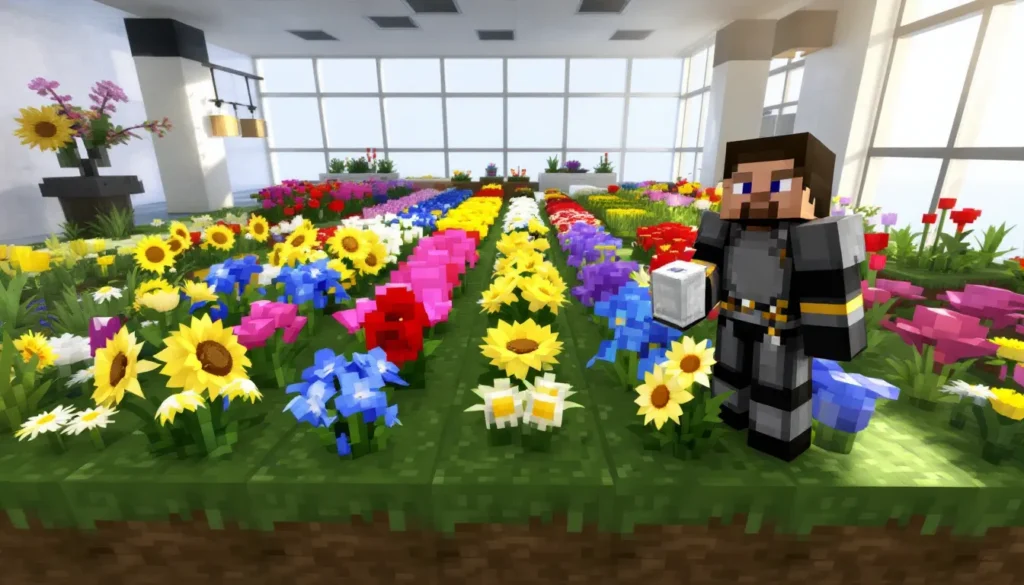
Flowers in Minecraft are more than just eye candy for your builds, they’re a cornerstone mechanic that ties together farming, crafting, breeding, and decoration. Whether you’re setting up your first garden or optimizing a massive flower farm for dye production, understanding how to cultivate and use Minecraft flowers effectively can save you hours and unlock new gameplay possibilities. From the humble dandelion to the elusive wither rose, all Minecraft flowers serve specific purposes, and knowing where to find them, how to grow them, and what to do with them is essential for any serious builder or survival mode player. This guide covers everything about flowers in Minecraft, their locations, growth mechanics, practical applications, and advanced automation techniques that’ll transform your gameplay experience.
Key Takeaways
- Minecraft flowers are essential for dye production, bee breeding, and decoration, making them fundamental to farming, crafting, and large-scale building projects.
- Bone meal is the most efficient tool for accelerating flower growth on grass block platforms, allowing players to scale production from manual harvesting to thousands of flowers per hour.
- Minecraft flower types vary by biome—common flowers like dandelions and poppies spawn in grassy areas, while rare variants like wither roses only appear when a wither kills mobs.
- Flowers planted in specific patterns create natural-looking terraforming and can be combined with bee nests to establish passive honey production systems through pollination mechanics.
- Automated flower farms using redstone dispensers, hoppers, and pistons can achieve 10,000–50,000 flower yields per hour, requiring planning but delivering significant resource savings for active builders.
- Flower mechanics differ slightly across Java Edition and Bedrock Edition, and version updates frequently introduce new flowers and adjust biome generation, so checking patch notes keeps farms optimized.
What Are Minecraft Flowers And Why They Matter
Minecraft flowers are decorative plant blocks that can be found throughout the world or grown intentionally by players. They’re categorized into two main types: small flowers (single block height) and tall flowers (two blocks tall). The significance of flowers in Minecraft extends far beyond aesthetics, they’re essential for several core mechanics.
Dyes are the primary reason most players care about flowers. Harvesting flowers and processing them through a crafting table yields dyes of various colors, which are used for coloring wool, beds, concrete, armor, and countless building materials. This makes flower farming crucial for any large-scale building project. Beyond dyes, flowers fuel the bee breeding system introduced in version 1.15, which opens up honey production, pollination mechanics, and additional farm automation possibilities.
Flowers also have niche but important uses: some players collect wither roses (the darkest flower available) for aesthetic reasons, while others use sunflowers for creating automated farms or redstone contraptions that detect specific biomes. Certain flowers are tied to specific biomes, making them collectibles for builders aiming to theme their builds accurately. Understanding the role flowers play in your playstyle, whether that’s pure decoration, dye production, or mechanical automation, determines how you’ll approach finding and cultivating them.
All Flower Types And Their Locations In The Overworld
Minecraft has a diverse roster of flowers scattered across different biomes and conditions. Knowing where to find each type is your first step toward building an efficient flower collection or farm.
Common Flowers And Where To Find Them
The most abundant flowers are dandelions and poppies, which spawn in nearly every grassy biome. Dandelions yield yellow dye, while poppies produce red dye, these two are the workhorses of color production and can be found in plains, forests, meadows, and flower forests with relative ease.
Blue orchids, alliums, and tulips are also fairly common across temperate biomes. Blue orchids are unique because they’re one of the few light blue dye sources, making them valuable for specific color palettes. Tulips come in white, pink, red, and orange varieties, each yielding a different dye color. Cornflowers and lilies of the valley round out the common roster, providing blue and white dyes respectively.
Daisy flowers spawn in meadow biomes and yield white dye. If you need a reliable source of a specific common flower, biome-specific farms are your best bet, most common flowers have dedicated biome preferences that make them predictable to locate.
Rare And Biome-Specific Flowers
Beyond the common flowers, several rare variants exist that require specific conditions or biomes to find. Sunflowers are taller flowers (occupying two blocks) that spawn exclusively in sunflower plains biomes. They’re sought after not just for their yellow dye but also because they face east when placed, a property useful for decorative builds and some redstone designs.
Wither roses are the rarest flowers in vanilla Minecraft. They don’t spawn naturally but only appear when a wither kills a mob. Collecting them requires either summoning a wither yourself or finding them in the Nether dimension. Their dark purple-black color makes them highly prized for decorative builds even though their limited availability.
Torchflower and pitcher plants are newer additions (as of version 1.20) found primarily in trial chambers and specific biome variants. These flowers represent cutting-edge flower mechanics and are still being optimized for use in farming systems. Peony and rose bush are tall flowers that spawn in forest biomes and yield pink and red dyes respectively, important if you’re targeting specific color outputs in large farms.
How To Plant And Grow Flowers Effectively
Growing flowers intentionally differs significantly from simply harvesting wild flowers. Understanding the mechanics behind flower growth is essential for setting up reliable farms or decorative gardens.
Planting Requirements And Conditions
Flowers require grass blocks or dirt blocks to be planted, they won’t grow on stone, gravel, or other solid blocks without dirt underneath. Place a flower on a valid block and it’ll remain planted. Unlike crops, flowers don’t require water proximity or hydration states to survive or grow, which simplifies farm design significantly.
Light levels matter for flower growth, but not in the way many players assume. Flowers don’t require specific light levels to exist: they’ll remain planted in darkness. But, for farms and aesthetic purposes, light typically comes into play when using bone meal to accelerate growth or when building in visible areas where visibility matters.
Temperature and biome type don’t directly affect individual flower growth, but biome type determines which flowers can spawn naturally in specific locations. This is why flower forests produce a wider variety of flowers compared to plains, the biome’s properties expand the flower pool.
Using Bone Meal For Faster Growth
Bone meal is the game-changer for flower farming. Using bone meal on grass blocks has a chance to generate flowers on nearby grass blocks, making it the primary method for scaling up flower production. A single bone meal can trigger multiple flower spawns in the area, though the exact count is random.
To maximize bone meal efficiency, create a 3×3 or larger platform of grass blocks and apply bone meal repeatedly. Over time, flowers will densify on the platform. This method is significantly faster than waiting for natural flower generation and allows targeted production of flower types in biome-appropriate areas.
Bone meal sources are typically skeletal remains from skeletons or wither skeletons, but can also come from composting plant materials. For serious flower farming, setting up a skeleton farm or obtaining bone meal through bulk crafting from specific farm setups becomes necessary. The investment pays dividends in flower production speed.
Crafting And Practical Uses For Flowers
Once you’ve harvested flowers, the real value comes from processing them into dyes and using those dyes for crafting and decoration.
Creating Dyes From Flowers
The crafting recipe is straightforward: place a flower in a crafting grid or inventory crafting window and it yields one dye of the corresponding color. Red flowers produce red dye, blue flowers produce blue dye, and so on. The dye type is deterministic based on the flower, there’s no randomness in the conversion process.
Multiple dyes can be combined to create new colors. Red dye plus white dye yields pink dye. Yellow dye plus blue dye yields green dye. This mixing system opens up color possibilities beyond the base flowers, though it requires planning if you’re working with limited dye quantities.
Large-scale builders often create dye stockpiles by running continuous flower farms and converting output into dye stores. With a proper farm setup and regular bone meal applications, a player can accumulate thousands of dyes for major building projects.
Decorative And Building Applications
Flowers are among the most visually diverse blocks in Minecraft. Each flower type has unique textures and colors that fit different aesthetic themes. Sunflowers work well in farmland-themed builds, while rose bushes suit fantasy gardens. Wither roses add a dark, ominous feel to nether-themed constructions or gothic builds.
Flowers planted in patterns create visual interest in terraforming. A meadow scattered with varied wildflowers looks far more organic than uniform grass. Professional builders often dedicate significant portions of their worlds to flower gardens that serve both as dye sources and as focal points for their bases.
Flowers can also be placed in pots as decoration, allowing for more intricate placement options and aesthetic refinement. Potted flowers take up less visual space while maintaining the color and style you’re aiming for.
Breeding Bees And Pollinating Flowers
The bee update (version 1.15) introduced a fascinating mechanic linking flowers directly to mob behavior and honey production. Bees navigate toward flowers within a certain radius and pollinate them, creating a dynamic ecosystem.
Bees will actively search for flowers and spend time pollinating them. When a bee completes pollination cycles, it carries pollen back to its nest or hive, which gradually fills with honey. This system incentivizes creating flower patches near bee nests if honey production is your goal.
Flower placement matters significantly for bee efficiency. Clustering diverse flowers together ensures bees find reliable food sources and complete pollination cycles faster. A well-designed bee farm pairs dense flower populations with strategically placed hives, creating a passive honey generation system.
Bees are also affected by weather, they remain inside hives during rain or nighttime, so farm output fluctuates with Minecraft’s day-night cycle. Planning for this variance ensures your honey storage scales appropriately. Several advanced players have designed redstone contraptions to automate honey collection from hives as bees fill them, though basic setups simply harvest honey periodically by hand.
The relationship between flowers and bees creates interdependency in farm design. You can’t maximize honey production without substantial flower populations, and you can’t maintain those populations without proper management.
Advanced Techniques: Flower Farms And Automation
Serious players scale flower production into industrial-level operations. These farms combine mechanics optimization, redstone automation, and spatial design to generate massive quantities of flowers and dyes.
Building An Efficient Flower Farm
The foundation of any flower farm is a large grass block platform. Players typically create 10×10 to 50×50 areas of grass blocks, depending on their dye needs and available resources. The platform should be in a biome known for producing diverse flowers, flower forests are ideal, but plains work too.
Bone meal is applied systematically across the platform. Some players use manual clicking, while others create redstone dispensers that apply bone meal automatically from hoppers. The hopper feeds from a connected storage system that keeps the farm supplied with bone meal from skeletal farms.
Flower collection can be manual or automated. For manual collection, players walk through and harvest with tools enchanted with Silk Touch (if they want to move flowers intact) or hand-harvest for seeds and dyes. Automated systems use hoppers positioned under flowers with a block-breaking mechanism, typically pistons or other contraptions that destroy flowers and funnel drops into hoppers.
According to Twinfinite guides, efficiency-focused farms often dedicate resources to dual-purpose setups where the same space produces both flowers and other valuable materials. Combining flower farms with skeletal farms or composting systems creates a self-sustaining loop where waste products feed back into the system.
Automated Harvesting Systems
Fully automated flower farms eliminate manual collection entirely. The most common design uses flying machines (pistons powering slime blocks in specific patterns) to push entities through the farm while hoppers collect falling flower drops.
Alternatively, some players use water currents to flow flowers toward a central collection point. This method is simpler to build but less customizable in terms of selective harvesting. The water pushes all mature flowers toward hoppers positioned at the convergence point.
Redstone automation introduces complexity but massive quality-of-life improvements. Repeaters, comparators, and observers can detect when flowers spawn and trigger dispensers or harvesting mechanisms. More advanced setups use string-based comparators to measure inventory fullness and pause bone meal application when storage reaches capacity.
Tools like Game8’s build guides catalog popular farm designs with specific metrics for output rates. Most optimized farms generate between 10,000 and 50,000 flowers per hour, depending on automation sophistication and available resources. The investment in redstone infrastructure typically pays off within hours of gameplay if you’re actively using dyes for building projects.
Testing different designs and measuring output over time helps identify which automation approach suits your building style and technical comfort level.
Flowers In Different Game Modes And Dimensions
Flower behavior and availability shift slightly across Minecraft’s various game modes and dimensions, which affects how you approach flower gathering and farming.
In Creative Mode, flowers are instantly available through the inventory, eliminating the need for farms. But, many builders still use creative farms for aesthetic purposes, designing elaborate flower gardens that showcase landscaping skills without resource constraints.
Survival Mode is where flower mechanics matter most. Limited resources mean every flower counts, and efficient farming becomes economically important. Hardcore Mode intensifies this further, as flower farm failures can lead to character death if redstone contraptions malfunction.
The Nether dimension features wither roses as the only naturally occurring flower. Finding wither roses requires summoning a wither in the Nether and letting it kill mobs, a dangerous but necessary process if you’re collecting every flower variant. No other flowers spawn naturally in Nether biomes, though you can transport flowers from the Overworld and plant them there for decoration or farming purposes.
The End dimension contains no flowers naturally. Flowers will remain planted if transported there, but they won’t spread or generate naturally. This limits End-based flower farming but doesn’t prevent decorative applications.
Flower availability also varies slightly between Java Edition and Bedrock Edition. Java Edition features the broadest flower roster and most stable farming mechanics. Bedrock Edition has identical flowers but slightly different spawn mechanics and farm designs sometimes require adjustment. Players switching between editions may notice subtle differences in flower distribution and biome generation affecting farm layout.
Version updates occasionally shift flower mechanics. Recent updates introduced new flowers and adjusted biome generation, so checking patch notes before investing heavily in farm designs ensures your setup remains optimal. Resources like IGN’s comprehensive guides track these changes across versions.
Conclusion
Minecraft flowers represent a deeper layer of gameplay than casual players often realize. From the simplest dandelion harvest to elaborate automated farms producing thousands of dyes per hour, flowers connect decorative creativity with mechanical mastery. Understanding all flower types, their locations, growth mechanics, and practical applications opens up new possibilities for your builds and farms.
Whether you’re focused on creating a visually stunning garden, establishing a dye production pipeline for major construction projects, or experimenting with bee-pollinated honey farms, the knowledge of how flowers work in Minecraft becomes increasingly valuable as your gameplay progresses. Start with basic collection and planting, scale into bone meal-accelerated farms once you understand the fundamentals, and eventually explore redstone automation for maximum efficiency.
The meta around flower farming continues to evolve with each update, so staying informed about patch changes and community-discovered optimization techniques keeps your builds and farms competitive. Your next Minecraft session is the perfect time to assess your current flower situation and plan an upgrade that matches your building ambitions.
More Stories
Mastering Command Blocks In Minecraft: The Complete 2026 Guide
How Does Mending Work in Minecraft? A Complete Guide to Repairing Your Gear in 2026
How To Build The Ultimate Mob Farm In Minecraft: Complete Guide For 2026