
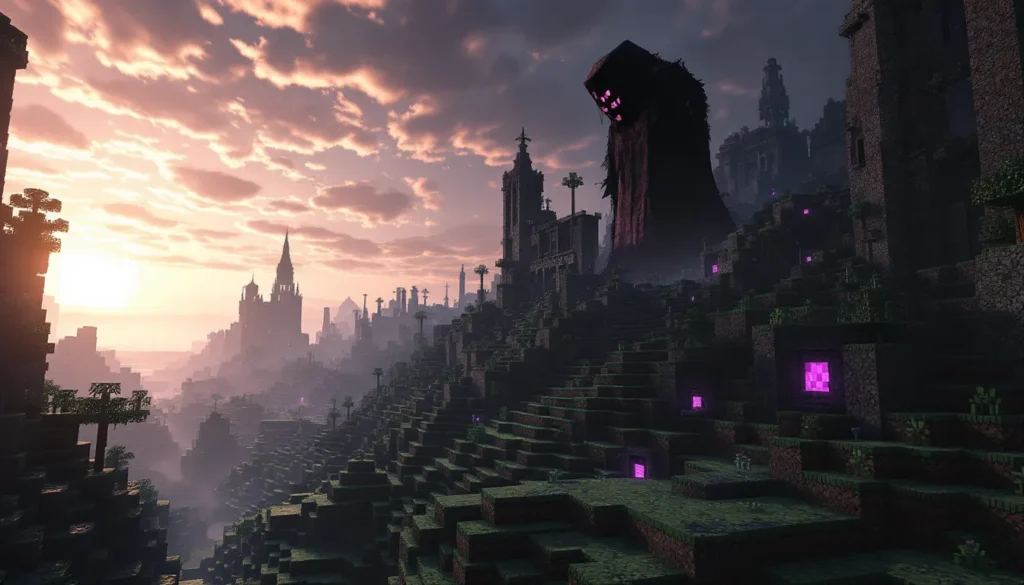
Minecraft’s blocky, cheerful aesthetic has made it one of the most accessible games on the planet. But venture deep enough into the internet, and you’ll find a twisted underbelly of cursed Minecraft images, screenshots so unsettling that they’ve become gaming folklore. These aren’t just poorly rendered textures or lag-induced glitches. They’re psychological artifacts that blur the line between innocent sandbox gameplay and genuine discomfort. Whether it’s a world warped into impossible geometry, mobs with distorted features, or structures that shouldn’t exist, cursed Minecraft pictures have become a cultural phenomenon that defines how communities create meaning around digital spaces. Understanding why these images resonate, and sometimes disturb, reveals something deeper about how gamers process familiar worlds gone wrong.
Key Takeaways
- Cursed Minecraft images exploit the uncanny valley by presenting familiar game elements—from mobs to landscapes—rendered subtly and disturbingly wrong, triggering psychological unease more effectively than overt horror.
- The phenomenon originated from early 2010s creepypasta traditions and evolved through iconic legends like Herobrine, which demonstrated how community storytelling can transform simple screenshots into influential cultural artifacts.
- Cursed Minecraft content is created through multiple methods including mods, texture pack modifications, deliberate glitches, actual data corruption, and digital editing, with communities now valuing the craftsmanship behind each approach.
- The impact of cursed Minecraft images extends beyond gameplay, influencing game design philosophy, community creative expression, and how modern developers engage with internet folklore and technical quirks.
- By 2026, cursed Minecraft imagery has matured into a recognized aesthetic category that proves communities can construct meaningful cultural products by blending technical reality, creative expression, and collaborative narratives around familiar digital spaces.
What Are Cursed Minecraft Images?
Cursed Minecraft images are screenshots, videos, or digital artwork depicting the game in unsettling, impossible, or deeply wrong ways. They’re not random bad screenshots, they’re intentionally or accidentally disturbing visual anomalies that subvert the game’s familiar, cozy aesthetic. A cursed image might show a Minecraft world with inverted colors, floating islands at wrong angles, mobs with missing faces, or terrain that defies the game’s normal generation rules.
The defining characteristic is that something is off in a way that triggers unease. It’s not about jump scares or gore, Minecraft doesn’t have that. Instead, cursed images exploit the uncanny valley: they take something recognizable (a Creeper, a forest, a house) and twist it into something subtly, disturbingly different. Your brain recognizes the game but rejects what it’s seeing as impossible or unnatural.
These images became especially prominent in gaming communities around 2015-2018, though the phenomenon has evolved significantly by 2026. What started as creepypasta-inspired horror lore has matured into a recognized aesthetic and meme format. Gamers share them ironically, seriously, and as inside jokes. Some are created intentionally through mods or texture packs: others emerge from actual game bugs or world corruption. Funny Minecraft pictures often play with this cursed aesthetic too, mixing humor with the unsettling vibe that makes these images so shareable.
The Origins of Cursed Minecraft Content
Early Internet Culture and Creepypasta Influence
Cursed Minecraft content didn’t emerge in a vacuum. It grew out of the creepypasta tradition, the internet’s love of crowdsourced horror stories shared on platforms like 4chan and Reddit. In the early 2010s, gaming creepypastas were at their peak, with writers crafting narratives around “haunted” games or disturbing mechanics. Minecraft, with its blocky simplicity and potential for modification, became an ideal canvas for this kind of storytelling.
The early creepypasta writers would combine unsettling text with imagery, some genuine screenshots, others heavily edited or fabricated. The visual component was crucial. A story about a cursed world meant nothing without a screenshot showing that twisted reality. Community members began sharing and remixing these images, adding layers of lore and interpretation. What made these images effective wasn’t technical quality: it was plausibility. Because Minecraft’s engine could theoretically generate broken worlds through corruption or mods, the images felt possible.
The Herobrine Legend and Its Impact
No discussion of cursed Minecraft content is complete without mentioning Herobrine, arguably the most influential creepypasta character in gaming history. Originating from a 2011 post on 4chan, Herobrine was described as a ghost-like entity haunting Minecraft worlds, Steve’s dead brother, according to the lore. The image that accompanied the story showed a tall, white-eyed figure in a Minecraft landscape, and that simple visual became iconic.
Herobrine’s impact was enormous. The legend spawned thousands of variations, fake screenshots, and community lore. Mojang (now Microsoft) eventually acknowledged the meme by adding “Removed Herobrine” to patch notes as an inside joke, which only amplified the cultural moment. Herobrine proved that cursed Minecraft images could achieve mainstream recognition and inspire genuine creative output from the community.
The character also established a template for how cursed Minecraft images should feel: eerie, lonely, and just barely plausible. Herobrine wasn’t cartoonishly evil: he was wrong, a figure that didn’t belong in Minecraft’s world. This psychological unease became the DNA of cursed content going forward, influencing everything from Entity 303 to null worlds.
Common Types of Cursed Minecraft Images
Glitched Worlds and Distorted Terrain
One of the most visually striking categories of cursed Minecraft images involves warped world generation. These images show landscapes that shouldn’t exist within Minecraft’s normal rules, floating chunks, inverted terrain, or islands suspended in the void at impossible angles. The Farlands is a famous example: at the edge of older Minecraft world borders (around X/Z coordinates ±30 million), terrain generation breaks down catastrophically, creating a visual nightmare of fractured blocks and distorted geometry.
What makes these images unsettling isn’t complexity: it’s violation. Players expect certain rules in Minecraft: gravity works, terrain generates predictably, the horizon has a reasonable rendering distance. When an image breaks these unspoken contracts, it triggers cognitive dissonance. A world tilted 45 degrees, chunks loaded at wrong angles, or floating bedrock platforms create a sense of wrongness that persists even when viewers intellectually understand the cause.
Corrupted Mobs and Entities
Mobs (Minecraft’s term for creatures) in cursed images often appear grotesquely malformed. Missing textures reveal purple-and-black checkered patterns underneath. Mobs might be stretched, duplicated, or merged together into horrifying amalgamations. A Creeper with a human face, a Zombie with inverted features, or an Enderman without its characteristic black silhouette, these variations exploit the uncanny valley by taking familiar enemies and rendering them subtly, disturbingly wrong.
The psychological power comes from recognition followed by rejection. Players know what these mobs should look like. Seeing them corrupted triggers a primal discomfort that’s more effective than overt gore or explicit horror. Some corrupted mob images are accidentally generated through texture pack conflicts or rendering bugs: others are deliberately crafted through image manipulation or shader modifications.
Unnatural Structures and Build Anomalies
Structures in cursed Minecraft images defy expected architecture and physics. Houses might have impossible geometries, windows that lead nowhere, staircases spiraling into void space, or buildings constructed from blocks that contradict each other visually. One famous category shows builds that are technically possible in Minecraft but feel architecturally wrong, structures designed with deliberate imperfection to trigger unease.
These images often include everyday Minecraft structures, simple houses, common mob farms, basic dungeons, but rendered in distorted, impossible ways. The horror isn’t in the content but in the execution. A perfect cube rotated 45 degrees in a 2D image, or a house rendered with perspective that shouldn’t be possible in isometric view, creates visual friction that makes viewers uncomfortable without them fully understanding why.
Eerie Atmospheric Effects and Lighting Errors
Lighting and atmosphere dramatically shift the tone of cursed Minecraft images. A normal landscape photographed with inverted colors, hyper-saturated tints, or corrupted lighting becomes immediately unsettling. Images showing perpetual darkness even though full daylight, or extreme brightness bleeding across the entire screen, create an oppressive sense of wrongness.
Texture corruption also plays a role here. When texture files become corrupted or misaligned, they create visual static and pattern disruption. A forest where all trees have transparent or missing textures, revealing the void behind them, or a sky rendered as pure black with geometric artifacts, these technical errors transform familiar environments into alien landscapes. The key is that the game itself appears broken, not just poorly rendered.
Why Players Find These Images Unsettling
Psychological Impact of Familiar Games Gone Wrong
Minecraft’s strength is its familiarity. Players spend hundreds or thousands of hours in worlds governed by consistent, learnable rules. The game is fundamentally safe, no permanent death, no real danger, a relaxing creative space. Cursed Minecraft images violate this safety by showing a version of the game where rules are broken and predictability collapses.
This is the uncanny valley in digital form. Psychologically, humans are most disturbed not by things that are completely alien, but by things that are almost right but not quite. A completely horrifying image is scary in an abstract way. A familiar game rendered wrongly, but, a game the player has internalized at a deep level, creates visceral unease. The brain recognizes the game but rejects the presentation as impossible or corrupted. This conflict generates discomfort that lingers longer than overt horror would.
The effect is amplified by context. A cursed image viewed alongside lore claiming it’s from a real haunted world, or attached to a story of a player’s corrupted save file, carries psychological weight beyond the image itself. The player’s emotional investment in Minecraft, their memories of building worlds, their attachment to the game’s aesthetic, gets inverted into a source of unease.
The Role of Community Storytelling and Rumors
Cursed Minecraft images derive much of their power from narrative framing. A random glitched screenshot means nothing: the same image paired with a creepypasta-style story about a corrupted world or a haunted save file becomes genuinely disturbing to many players. The community constructs meaning collaboratively through storytelling, lore-building, and creative reinterpretation.
Rumors amplify this effect. When a cursed image circulates with a story, “someone found this in their 2009 Minecraft folder,” “this is what happens if you reach the Far Lands,” “Mojang removed this texture after someone reported it”, players are primed to interpret the image through that narrative frame. The image becomes evidence of something larger and more sinister. Even when players intellectually understand the image is edited or deliberately created, the emotional response persists because the community has collectively invested it with meaning.
This dynamic has evolved by 2026. Younger players encountering cursed images often don’t know (or don’t believe) the origin stories. To them, the images are simply unsettling without needing elaborate creepypasta backing. The phenomenon has become self-sustaining: cursed images are unsettling because they’re labeled cursed, because the community treats them that way, and because that treatment has created an aesthetic category that readers now recognize and respond to.
Famous Cursed Minecraft Images and Their Stories
Null Worlds and Farlands
The Null World is a technical term with haunting connotations. In Minecraft, chunks that fail to generate properly become “null”, they don’t render correctly, display as corrupted, or appear as empty voids. The visual result is a fractured, impossible landscape where normal terrain generation breaks down. Because the Null World actually exists as a technical phenomenon (it’s how the game handles certain coordinate errors), images claiming to show it feel plausibly real.
The Farlands are equally famous. At extreme coordinates (around ±30,000,000 blocks), Minecraft’s world generation engine breaks down due to floating-point precision limits. Terrain becomes increasingly distorted and impossible the farther you go, creating a visual landscape that’s genuinely disturbing to explore. Unlike the Null World, the Farlands are completely real, players can actually reach them with modern versions of Minecraft on PC. Videos and images from the Farlands have become iconic in cursed Minecraft culture because they’re documented proof that the game’s world has a horrifying edge.
The Missing Textures Phenomenon
When texture files are missing or corrupted in Minecraft, the game displays a purple-and-black checkered placeholder pattern. This “missing texture” aesthetic has become a crucial element of cursed imagery. Images showing entire biomes rendered in the checkered pattern, forests of purple checkers, skies of checkers, whole worlds stripped of visual identity, feel deeply wrong. It’s as if the world itself has been erased, leaving only an error message.
Some of the most effective cursed images exploit this by showing partially corrupted worlds: a normal landscape gradually transitioning into sections of missing textures, as if reality is degrading. The visual is simple but deeply unsettling because it suggests corruption spreading, a world failing before the viewer’s eyes. The missing texture pattern has become so associated with cursed imagery that seeing it now triggers automatic unease in many players.
Entity 303 and Other Internet Legends
Entity 303 emerged in the early 2010s as a creepypasta character, a dark entity that haunts multiplayer servers, corrupts worlds, and deletes players’ files. Unlike Herobrine, which became somewhat lighthearted and meme-ified, Entity 303 retained a genuinely sinister reputation. Images associated with Entity 303 lore typically show corrupted biomes, deleted chunks, or impossible structures, all framed as evidence of the entity’s destructive presence.
Other internet legends include Steve? (a malevolent version of the player character), the Minecraft Creepypasta monsters (Slenderman-inspired entities), and various region-specific haunting narratives. What these legends share is a structure: a corrupted or impossible image paired with a story explaining the visual anomaly as supernatural or malevolent rather than technical. The image becomes proof of the legend’s existence.
By 2026, these legends have achieved a kind of mythic status in gaming culture. New players encounter them secondhand, through references in content, community jokes, or curated compilations. The legends have influenced how cursed images are created and interpreted. Creators now deliberately craft images that fit the aesthetic and narrative templates established by Herobrine, Entity 303, and similar figures. The legends have become a lingua franca for cursed Minecraft content.
How Cursed Images Are Created
Mods, Texture Packs, and Intentional Glitches
Many modern cursed Minecraft images are deliberately crafted using mods and custom texture packs. A creator might use Nexus Mods to find or develop mods that deliberately break world generation, corrupt mob textures, or disable lighting calculations. This approach gives creators precise control over the unsettling elements.
Texture pack modifications are equally popular. A custom texture pack might replace all textures with corrupted or distorted versions, invert colors, or introduce visual artifacts. Some texture packs are designed specifically to create a cursed aesthetic, replacing normal mobs with distorted variants, trees with twisted versions, and landscapes with geometrically impossible terrain. These packs are often released as curiosity pieces, and players use them to generate new cursed images.
Intentional glitches are another strategy. Creators manipulate save files, use command blocks to create impossible structures, or exploit rendering bugs in specific Minecraft versions to generate desired effects. Because different versions of Minecraft have different quirks and bugs, skilled creators can target specific visual anomalies. The advantage of this approach is plausibility: an image created through in-game manipulation looks more authentically cursed than one that’s been heavily edited.
Data Corruption and World Generation Errors
Some cursed images originate from actual technical problems. When a Minecraft world file becomes corrupted, through mod conflicts, crashes, or file system errors, terrain can generate incorrectly, mobs can be malformed, and visual glitches can spread through the world. Screenshots of genuinely corrupted worlds are particularly effective cursed images because they’re authentic accidents rather than intentional creations.
World generation errors are especially potent. If a player updates their Minecraft version or changes world generation settings incorrectly, old chunks might fail to generate properly when reloaded. An image showing a perfect chunk boundary where terrain suddenly becomes impossible, a world split between normal and corrupted, is both authentic and deeply unsettling.
Data corruption also creates the missing texture phenomenon mentioned earlier. When texture files are damaged or deleted, Minecraft displays the purple-and-black checkered pattern. A screenshot from a world where significant texture corruption has occurred becomes a powerful cursed image because it’s documenting real system failure, not artistic manipulation.
Creative Editing and Digital Manipulation
Not all cursed images are generated in-game. Many are created through post-processing using image editing software. A creator might start with a normal Minecraft screenshot and apply distortions: inverting colors, stretching the image, applying noise filters, or layering corrupted elements. Advanced editing can create effects that would be difficult or impossible to generate in-game.
Some cursed images blend multiple sources. A normal landscape might be combined with distorted entity textures, missing texture patterns, or impossible geometry pasted from other sources. The result is a convincing composite that looks like it could be a real in-game screenshot, even though it’s been substantially manipulated.
By 2026, community members have become sophisticated about distinguishing between authentic glitches, in-game creations, and edited images. Experienced players can often identify the creation method by analyzing artifacts, compression patterns, and consistency. But, this technical literacy hasn’t diminished the impact of cursed images, it’s simply shifted the culture toward appreciation of craftsmanship and creativity. An exceptionally well-executed cursed image, whether authentic or edited, earns community respect for the skill involved in making it convincing and unsettling.
The Cultural Impact on Minecraft and Gaming
Influence on Game Design and Developer Responses
Cursed Minecraft content hasn’t directly changed how Minecraft is developed, but it has influenced Mojang’s communication with the community. The Herobrine “Removed” easter egg in patch notes became an ongoing inside joke with developers, acknowledging the cultural phenomenon without treating it as genuinely threatening. This approach, playful engagement with community lore, set a template for how modern game developers interact with internet folklore.
The broader impact has been on how games are discussed. Cursed images demonstrated that communities could build rich narrative and creative culture around unintended or technical phenomena. Game developers now recognize that glitches, world-breaking edge cases, and unusual technical states can become sources of player engagement and creativity. Some modern games deliberately include Easter eggs or dev commentary on famous glitches, turning technical quirks into features.
Cursed Minecraft content also influenced visual design philosophy in indie games. The uncanny valley effect that makes cursed images work has become a recognized aesthetic tool. Games exploring horror, unease, or surrealism now often deliberately employ familiar visual language rendered wrongly, similar to the approach established by cursed Minecraft culture. Developers understand that subtle wrongness is more psychologically effective than overt grotesqueness.
Cursed Content’s Role in Gaming Communities
Cursed Minecraft images became a vital part of how gaming communities express creativity and build shared culture. They’re not just horror content: they’re collaborative art. IGN and other major gaming outlets have covered cursed Minecraft phenomena, helping legitimize the aesthetic as a genuine cultural category. What started as 4chan creepypastas evolved into a recognized meme format, then a legitimate artistic aesthetic.
The community dimensions are significant. Discord servers, Reddit communities, and YouTube channels dedicated to cursed Minecraft content host thousands of active members. Creators share their work, provide feedback, and collaborate on lore-building. This has created a self-sustaining ecosystem where new creators encounter the aesthetic, learn the conventions, and produce their own variations. Funny Minecraft pictures often incorporate cursed aesthetic elements now, showing how the style has mainstream acceptance.
Cursed content has also provided creative outlets for players who might not be interested in traditional Minecraft gameplay. Building and survival are primary game modes, but creating unsettling screenshots and composing narratives around them is a parallel form of creative expression entirely within the community. Shacknews and similar gaming outlets regularly feature community creations, giving cursed content creators visibility and legitimacy.
By 2026, cursed Minecraft imagery has become integrated into broader gaming culture. New players encounter it as part of the game’s lore landscape. The phenomenon proves that player communities can construct meaningful cultural products from game systems, technical quirks, and collaborative storytelling. Cursed Minecraft images are simultaneously authentic expressions of technical realities and entirely fictional narratives, and the community understands and values both aspects simultaneously.
Conclusion
Cursed Minecraft images represent something genuinely interesting in gaming culture: the point where technical reality, creative expression, and community storytelling converge. They’re not just screenshots of glitches or horror content. They’re evidence of how gaming communities construct meaning, build narrative frameworks, and create art within and around the systems they engage with daily.
The phenomenon started with creepypasta influences and Herobrine, evolved through accumulated internet lore and technical discoveries like the Farlands, and has matured into a recognized aesthetic category that influences how modern games are discussed and designed. Players understand the multiple layers, technical glitches, intentional creations, edited composites, and collaborative narratives, and appreciate the cultural work that goes into all of them.
What makes cursed Minecraft images persist in 2026 is that they’re psychologically effective. They exploit the uncanny valley by taking something players know intimately and rendering it subtly, disturbingly wrong. They prove that horror and unease don’t require explicit gore or jump scares, they emerge from violation of expected rules and corruption of the familiar. That’s a lesson game designers, artists, and storytellers continue to draw from.
For players, cursed Minecraft images remain a space for creative expression, community participation, and exploration of how meaning gets constructed around digital spaces. Whether genuinely disturbing, ironically enjoyed, or simply appreciated for technical craft, these images continue to haunt the Minecraft community because they touch something fundamental: the power of the familiar made strange.
More Stories
Mastering Command Blocks In Minecraft: The Complete 2026 Guide
How Does Mending Work in Minecraft? A Complete Guide to Repairing Your Gear in 2026
How To Build The Ultimate Mob Farm In Minecraft: Complete Guide For 2026