
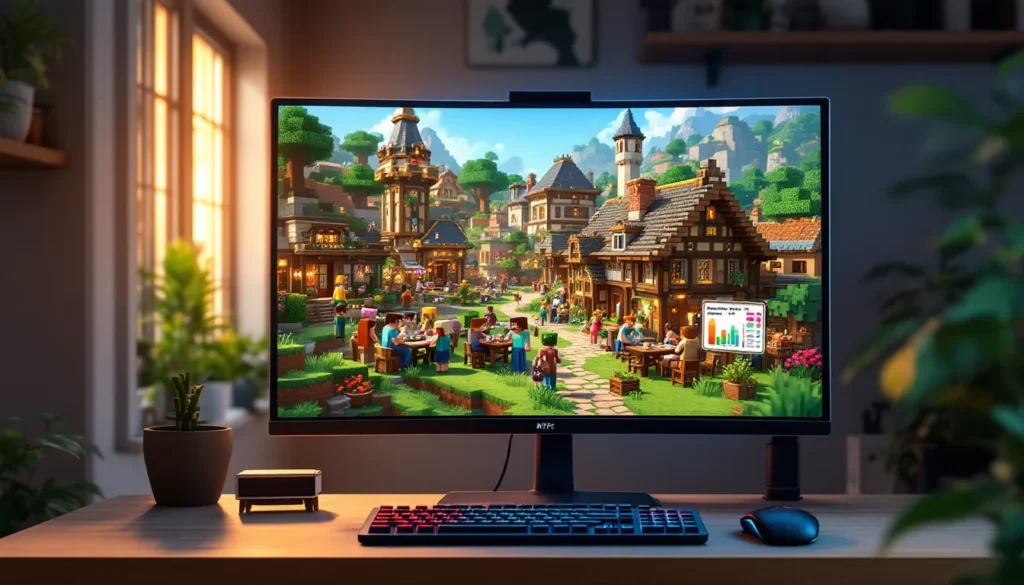
Minecraft’s biggest strength has always been its sandbox, total freedom to build, explore, and survive on your own terms. But after hundreds of hours of mining and crafting, even the most dedicated players hit a wall. The world feels empty. Your villages stay lifeless. Enter Minecraft Comes Alive, a mod that fundamentally reshapes how you interact with NPCs and transforms the vanilla experience into something genuinely alive. Instead of trading with emotionless villagers, you’re building relationships, starting families, and watching your world evolve through real NPC personality and progression systems. Whether you’re a veteran mod user or someone who’s never touched a mod before, this guide covers everything you need to know about bringing your Minecraft world to life in 2026.
Key Takeaways
- Minecraft Comes Alive transforms empty villages into dynamic communities by introducing NPCs with individual personalities, daily routines, and genuine relationship mechanics that evolve based on your interactions.
- The mod supports diverse playstyles through extensive customization options, allowing you to adjust relationship progression speeds, family mechanics, NPC spawn rates, and village functionality to match your preferences.
- Successful village management requires patience and consistent interaction—building relationships, providing thoughtful gifts, and creating community infrastructure like taverns and gathering spaces where NPCs naturally socialize.
- MCA is compatible with most popular mods like Waystones and FarmersDelight, but requires a fresh world to generate villages properly and performs best with 40-50 NPCs to maintain optimal frame rates.
- Marriage, families, and NPC professions are fully optional systems that reward long-term engagement, with children aging over time and NPCs developing rivalries that create organic, unscripted village drama.
What Is Minecraft Comes Alive?
Minecraft Comes Alive (or MCA) is a comprehensive overhaul mod that injects personality, depth, and long-term progression into Minecraft’s NPC systems. Instead of the standard wooden-faced villagers who only exist to trade emeralds, the mod generates NPCs with individual traits, dialogue, schedules, and genuine relationship mechanics. You can marry NPCs, start a family, manage a household, and watch your village develop organically over time.
The Minecraft Comes Alive mod has been around for years, but the reborn version represents a modernized rebuild for current Minecraft versions. This newer iteration fixes compatibility issues, adds refined mechanics, and ensures the mod works smoothly with 1.18+ versions. The core appeal remains unchanged: it’s the difference between governing a collection of automated trade partners and actually living in a community where NPCs have daily routines, opinions, and story arcs that evolve based on your interactions.
What separates MCA from other village-focused mods is its focus on human relationships rather than just gameplay optimization. There’s no hidden “affection meter” displayed in a UI, instead, NPCs react to you based on how you treat them. Give gifts, help with tasks, and maintain conversations, and they’ll warm up to you. Neglect or disrespect them, and they’ll remember it. This systems-driven approach means every player’s village tells a different story.
Key Features And What Sets It Apart
NPC Interactions And Relationships
The heart of MCA is its dialogue and relationship system. NPCs aren’t generic: they have names, ages, personalities, and preferences. You’ll encounter fishermen with dry humor, merchants with ambition, and guards with protective streaks. Each NPC has specific dialogue chains triggered by context, talking to someone after they’ve had a bad day yields different responses than catching them in good spirits.
Relationships work on a spectrum from hostile to romantic. You can befriend NPCs, court them, get married, and start a family. Marriage isn’t just flavor, it unlocks household management features, allows spouses to help with tasks, and opens up parenting mechanics where you can raise children in-game. Some players skip the romance route entirely and focus on building a tight-knit village community of trusted allies. The mod scales to your playstyle.
Gifts matter. NPCs remember what you give them and react accordingly. A well-timed present can accelerate a relationship or resolve conflict. There’s strategy here, figuring out what each NPC actually wants requires observation and conversation.
Customization Options
MCA lets you customize virtually every aspect of how villages and NPCs function. Server admins and single-player controllers can adjust relationship progression speeds, gift requirements, marriage conditions, and NPC spawn rates. This flexibility is crucial because different players want different experiences, some want rapid relationship progression for quick romance gameplay, while others prefer a slow burn that feels organic.
You can also customize NPC appearance through settings, control fertility and family size limits, and configure how children age. Some players treat it as a family simulator: others use it for casual village building. The mod doesn’t force any particular playstyle, it provides systems and lets you define your goals.
NPC profession distribution can be managed too. If your village needs more farmers and fewer librarians, you can adjust spawn weights or manually assign roles. This ensures your village develops functionally rather than randomly.
How To Install And Set Up Minecraft Comes Alive
System Requirements And Compatibility
Minecraft Comes Alive requires a modding framework, specifically Forge or Fabric, depending on the mod version. As of 2026, the most stable builds are for 1.20.1 and 1.21+ on Fabric, with older Forge versions still available for 1.18-1.19 players who haven’t updated.
Minimum specs are modest: if you can run vanilla Minecraft smoothly, MCA won’t tank performance. But, the mod does add entity processing (NPCs are tracked and simulated constantly), so systems with less than 4GB RAM dedicated to Minecraft might experience stuttering in villages with 50+ NPCs. Most gaming PCs have zero issues: laptops and older machines should monitor FPS in populated areas.
Compatibility is generally strong. MCA plays well with most world-gen mods (like Terralith or Biomes O’ Plenty), village decoration mods (like Waystones), and utility mods (like Modular Routers or Applied Energistics). But, some mods that heavily modify villager mechanics can conflict. Always check the mod page or community forums for known incompatibilities before installing alongside other village-focused mods.
Step-By-Step Installation Guide
Step 1: Download the correct version. Head to Nexus Mods or the official CurseForge page. Identify your Minecraft version (1.20.1, 1.21, etc.) and modloader preference. Download the JAR file matching both.
Step 2: Install your modloader. If you haven’t already, download Forge or Fabric installer for your version. Run the installer and select “Install client.” This creates a mods folder in your .minecraft directory.
Step 3: Place the mod JAR. Drop the downloaded Minecraft Comes Alive JAR file into your mods folder (usually at C:Users[YourName]AppDataRoaming.minecraftmods on Windows or ~/Library/Application Support/minecraft/mods on Mac).
Step 4: Launch the game. Open your Minecraft launcher, create a profile for your modloader version, and launch. The game will initialize the mod on first load, this takes a minute or two longer than normal, which is expected.
Step 5: Configure settings. Once in-game, check your mods list (usually ESC > Mods). Click Minecraft Comes Alive and access its config file. Adjust relationship speeds, NPC spawn rates, and family mechanics to your preference. Save and restart if you make changes.
Step 6: Create a new world. Don’t load an old world: MCA works best on fresh worlds where it can generate villages properly. Select “Create New World,” load up, and you should see NPCs in villages immediately.
Gameplay Mechanics And Core Systems
Building And Managing Your Village
Once the mod is running, villages become dynamic. NPCs will construct their own homes if housing is available, assign themselves professions based on available workstations, and develop daily routines. You’ll see them farming, crafting, socializing, and sleeping. It’s the vanilla village system reimagined with actual life happening.
You can accelerate this by placing workstations (farmers’ blocks, lecterns, brewing stands, etc.) and ensuring adequate housing. NPCs are attracted to functional villages. If you build a cottage with a bed and furnish it properly, an NPC will eventually claim it. This creates organic settlement expansion, you’re not managing a city, you’re fostering the conditions for one to develop.
Custom houses can be built too. Design a space, add furniture and beds, and mark it as available. NPCs will evaluate housing based on comfort, amenities, and location. A well-decorated home with a view attracts better-quality NPCs. A cramped, ugly shack still gets claimed, by someone, but prioritization happens.
NPC Professions And Trades
Unlike vanilla villages, MCA NPCs have personality-driven professions. A librarian isn’t just a librarian, they might be studious and reclusive, or they might be outgoing and love teaching. This affects their dialogue, their trade quality, and how they interact with the community.
Each profession has tier progression. A novice farmer knows the basics: a master farmer has unlocked special seeds or better crop yields. Progression happens over time as NPCs work their stations. This means your early village feels less developed than your village after 50 in-game days, and that’s intentional. There’s a sense of growth.
Trades themselves remain Minecraft-standard (emeralds, specific items), but the context changes. Trading with someone you’ve built a relationship with feels different than with a stranger. Some NPCs offer better rates to trusted customers: others might refuse to trade if they dislike you.
Marriage And Family Systems
Marriage is entirely optional but deeply integrated into the mod. Courting an NPC involves consistent interaction, gift-giving, and maintaining positive sentiment. Once married, spouses help with tasks, contribute to household decisions, and can have children.
Children grow over time. You can teach them crafting recipes, send them to gather resources, or just watch them age from infants to teenagers. Some players use this for roleplay: others treat children as a renewable labor force. The mod doesn’t judge, it provides the mechanics.
Divorce is possible but carries consequences. NPCs remember broken relationships, and village reputation shifts if you abandon a spouse publicly. Mortality exists too, NPCs can age and pass away, which is handled respectfully. Death isn’t arbitrary: it’s tied to age and can be toggled in settings. Some players disable it entirely for relaxation: others embrace it for permanence.
Essential Tips And Strategies For Success
Optimizing NPC Relationships
Start conversations early. Talk to new NPCs immediately, this establishes baseline familiarity and teaches you their name and personality. Personality types include friendly, shy, gloomy, and aggressive, each responding differently to similar gestures.
Gifts accelerate relationships faster than dialogue alone. Flowers work on most NPCs: axes work on lumberjacks: seeds work on farmers. Pay attention to NPC dialogue, they drop hints about preferences. An NPC who talks about flowers loves flowers. A merchant who mentions nice things responds to luxury items like diamonds or enchanted gear.
Timing matters. Don’t approach an NPC immediately after a village raid when they’re stressed, or while they’re working if they’re focused. Evening or leisure time yields better conversation results. This is subtle, the game doesn’t explicitly say “this NPC is busy,” but you’ll notice patterns.
Avoid public disrespect. If you hit an NPC or steal from their house, reputation tanks publicly. Other villagers notice and judge you. In contrast, private negative actions (refusing a trade, dismissing dialogue) have softer consequences. Play politics.
Managing Resources And Economy
Your village’s economy is simplified but real. NPCs use emeralds and trade them for goods. If you flood the market with mined emeralds, prices don’t adjust, but if your NPCs are wealthy, they have more buying power and can afford rarer trades.
Focus on establishing productive NPCs early. A farmer, a miner, a lumberjack, and a merchant create the foundation of resource flow. These four professions solve 80% of supply needs. Layer in specialists (blacksmiths, librarians, fishermen) based on your goals.
Don’t over-optimize. Yes, you could engineer a perfect village with perfect ratios and maximum efficiency. But part of MCA’s appeal is watching your village evolve imperfectly. Let NPCs settle naturally, develop friendships (and rivalries), and create unexpected dynamics. The best villages are messy.
Avoiding Common Mistakes
Don’t isolate your village. Build taverns, gathering spaces, and paths that encourage NPCs to socialize. Isolated NPCs become sad and disengage. A functional community requires infrastructure for being a community.
Don’t ignore housing. NPCs without homes or with terrible housing become hostile. They’ll leave your village or refuse to work. Always ensure adequate housing before expanding your population.
Don’t expect instant results. Relationships, marriages, and child-rearing are slow. If you want romantic progression in the first day, you’ll be disappointed. MCA rewards patience and long-term play. Think in seasons, not hours.
Don’t forget about conflicts. Rivalries develop naturally. Two NPCs might dislike each other, creating tension in your village. This is a feature, not a bug, it forces you to mediate or live with drama. Some players love this: others disable aggressive NPC interactions in config.
Mod Compatibility And Enhanced Features
Popular Companion Mods
Minecraft Comes Alive pairs beautifully with complementary mods. 6 Games Minecraft Fans explores adjacent gaming experiences, but in terms of mods specifically, certain additions enhance MCA synergy.
Waystones (by Darkhax) adds fast-travel shrines. This is crucial for larger villages, without it, NPCs spend half their day traveling. Waystones keeps them in-village longer, increasing interaction frequency.
Villager Names and Skins (various authors) layers additional customization. MCA NPCs have names, but these companion mods add visual variety. Combined, you get a village that looks and feels like a real community.
FarmersDelight and Cooking for Blockheads integrate beautifully. They don’t directly modify MCA, but they give NPCs more complex tasks and create richer interactions around food preparation and dining. Imagine a village where NPCs cook together, these mods enable that.
For relationship-focused players, Romance Mod (if compatible with your version) adds an extra layer of depth. Check compatibility carefully: not all versions of MCA sync perfectly with all relationship mods.
Performance Optimization
MCA adds entity processing overhead. Each NPC is tracked, simulated, and rendered. With 60+ NPCs, even modern systems notice the difference. Here’s how to optimize:
Reduce NPC despawn distance. In config, lower the render distance for distant NPCs. They’ll still exist and work, but your client won’t render them if they’re far away. This saves significant frame rate without gameplay impact.
Enable simulation distance culling. If your modloader supports it, disable NPC simulation when they’re outside a certain radius. They’ll pause activity but resume when you’re near. It’s imperceptible and cuts CPU load dramatically.
Limit village size. There’s no “perfect” village population, but 40-50 NPCs is the comfort zone for most systems. Beyond that, performance degrades. Focus on quality NPCs rather than quantity.
Optimize world generation mods. If you’re running MCA with multiple biome and structure mods, world gen can bottleneck initial load. Use a tool like Why No Two Minecraft to understand terrain generation impact, then disable unnecessary biome mods if needed.
Troubleshooting Common Issues
Installation Problems
Mod won’t load. Verify your Minecraft version matches the mod version exactly. 1.20.1 mod won’t load in 1.21 game. Check CurseForge or Nexus pages for version compatibility lists. Also confirm your modloader (Forge vs. Fabric) is installed correctly. Run the installer again if unsure.
Mods folder doesn’t exist. It’s created automatically on first modloader launch. If it’s missing, reinstall your modloader. The installer should prompt you: select “Install client” explicitly.
Game crashes on startup. Check your launcher logs (usually in the launcher’s console output). Common culprits are missing dependencies (MCA might require additional libraries) or conflicting mods. Remove all mods except MCA, launch, verify it works, then add others one by one to find the conflict.
NPCs aren’t spawning. Verify you created a NEW world after installing the mod. Old worlds won’t generate MCA villages. If NPCs still don’t appear, check your config, NPC spawn rate might be set to 0. Also ensure there are empty houses or housing blocks available. NPCs won’t spawn in villages with no housing.
Gameplay Bugs And Fixes
NPCs freezing or standing still. This usually indicates a pathfinding issue. NPCs can’t reach their workstations or homes due to missing blocks or obstructed paths. Clear obstacles around important buildings and ensure there’s a direct path from homes to workstations. Reloading the chunk (moving away and back) often fixes temporary freezes.
Relationships not progressing. Verify you’re actually interacting. Talking to an NPC once doesn’t establish a relationship. You need consistent, positive interactions over multiple days. Check your config settings, if relationship progression is slowed to “glacial,” it’ll feel broken when it’s just slow. Adjust speed if you want faster progression.
Marriages not triggering. You need to reach maximum relationship status first. This is several full relationships progression bars, it’s intentionally slow. Some players mistake “friendly” for “ready to marry.” Keep interacting until an NPC explicitly proposes or mentions commitment. Also verify your config allows marriages: some servers disable them.
Children disappearing. Children age slowly. They don’t vanish, they just age into teenagers, then young adults. If a child is truly missing, check if they were killed in a raid. NPCs can die, including children. Some players disable damage to prevent this.
Performance tanking in villages. Too many NPCs or mobs. Check your entity count (debug screen in most Minecraft versions). If NPCs are climbing above 50, performance will suffer. Consider moving your village or reducing spawn rates. Alternatively, optimize as mentioned in the earlier section. A guide like Minecraft: The World Gaming covers broader Minecraft optimization that applies to modded play too.
Mod conflicts causing weird NPC behavior. MCA interacts deeply with villager AI. Mods that modify villager behavior (like Repurposed Structures or others that alter profession logic) can cause NPCs to ignore workstations or behave erratically. Check mod pages for known conflicts. If you suspect a conflict, try loading only MCA and your game-critical mods (like How To Hack Minecraft features if you’re using optimization mods) and test.
Conclusion
Minecraft Comes Alive Reborn transforms vanilla villages from silent, emotionless trading posts into living communities. It adds depth without requiring you to master complex mechanics, the systems are intuitive once you understand that NPCs are individuals with preferences, daily routines, and real relationships.
The mod thrives on long-term engagement. One-off play sessions won’t showcase its strengths: you need to invest time, build relationships, and watch your village evolve. That’s not a flaw, it’s the entire point. For players who’ve exhausted vanilla Minecraft and want a reason to keep building, MCA delivers.
Whether you’re running it solo for relaxation, using it for roleplay, or optimizing it for competitive village efficiency, there’s a playstyle that fits. Start fresh, take your time with NPCs, and let your world tell its own story. The barrier to entry is just a mod file and a willingness to engage with systems that reward patience. From there, your village writes itself.
If you’re serious about enhancing your Minecraft experience, guides like The Hidden Lore and broader community resources offer complementary knowledge. Combine those with MCA’s community features, and you’re running one of the richest vanilla-plus experiences available in 2026.
More Stories
Inside ThePlayCentre Minecraft Archives: A 2026 Guide To Maps, Builds, And Community History
Bane Of Arthropods In Minecraft: Master The Enchantment In 2026 (ThePlayCentre Guide)
Minecraft Adventure Tulip Purchase Review: Is ThePlayCEN.org Worth It In 2026?